
Why Is Bioskills Lab Education Important?
Why Is Bioskills Lab Education Important?
Bioskills lab education connects medical theory with the physical realities of patient care. Learners can handle instruments, tissue models, implants, and ultrasound equipment before entering a clinical setting. They can feel resistance, adjust hand pressure, and repeat difficult steps safely. That experience matters.
The World Health Organization reports that approximately one in ten patients experiences harm during healthcare, with more than half considered preventable. Its Global Patient Safety Action Plan 2021–2030 emphasizes stronger training, practical competency, and safer systems. The Association of American Medical Colleges also projected a United States physician shortage of up to 86,000 doctors by 2036 in its 2024 workforce report. These pressures make efficient, measurable training increasingly important.
David Gaba, a leading medical simulation researcher, wrote, “Simulation is a technique—not a technology—to replace or amplify real experiences with guided experiences.” Bioskills lab education applies this principle through supervised practice, structured feedback, and objective assessment. A resident can repeat a suturing technique, review bleeding control, and correct positioning before treating a real patient.
The laboratory is not a perfect mirror of surgery. Human stress, unexpected anatomy, and team communication remain difficult to reproduce. That limitation deserves honesty. Still, realistic practice can reveal weak technique early. It can also build confidence without exposing patients to avoidable risk. Strong programs should combine expert instruction, validated assessment tools, documented outcomes, and continuous curriculum review. The goal is not simply more practice. It is safer, more thoughtful performance when practice becomes patient care.
What Bioskills Lab Education Involves
Why Is Bioskills Lab Education Important?
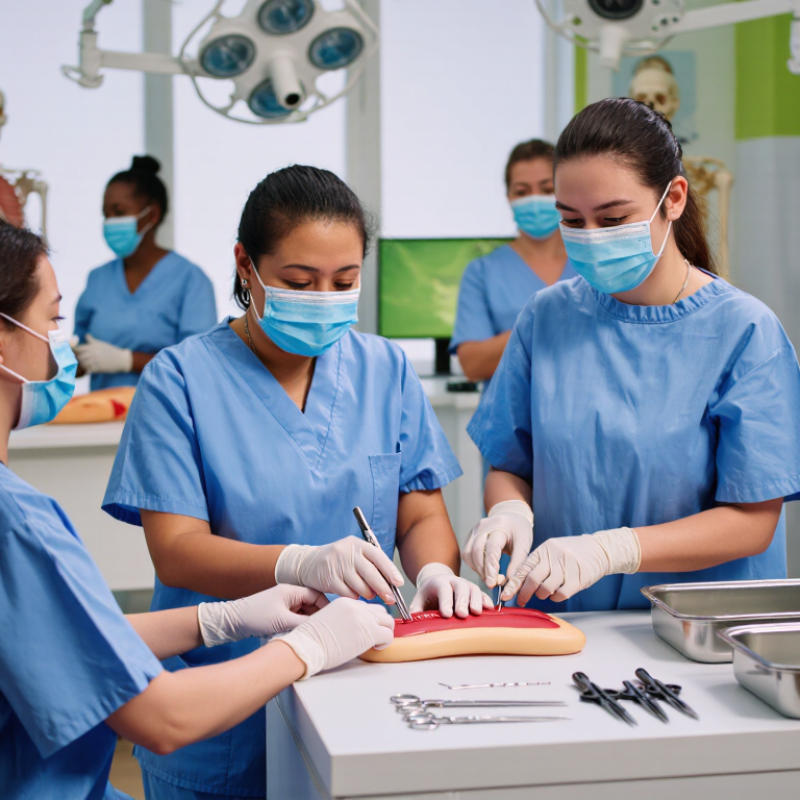
Bioskills lab education involves supervised, hands-on practice in a controlled clinical setting. Learners may work with anatomical specimens, high-fidelity models, imaging tools, and task trainers. They rehearse positioning, tissue handling, device control, suturing, and emergency responses. Instructors observe each movement and correct technique before patient contact.
The World Health Organization reports that around one in ten patients experiences harm during healthcare, with more than half considered preventable. This makes practical preparation more than a classroom exercise. In a lab, a learner can repeat a difficult step, feel resistance, and identify poor hand placement without creating patient risk. Errors become visible. That feedback is valuable.
A useful session also includes briefing, consent procedures, infection-control practice, equipment checks, and structured debriefing. The Association of American Medical Colleges’ 2023 data show that medical schools continue expanding simulation and skills-based learning within clinical training. Yet simulation is not identical to live care. A model can still mislead. Experienced educators should explain its limits, record performance, and connect each task to current clinical guidance. Learners should also reflect honestly. Confidence may rise faster than competence, and that gap deserves attention.
Why Is Bioskills Lab Education Important? - What Bioskills Lab Education Involves
| Education Dimension | What It Involves | Why It Is Important | Typical Evidence of Learning |
|---|---|---|---|
| Anatomy and Orientation | Reviewing relevant anatomy, tissue planes, landmarks, and anatomical variation using human specimens or validated simulation models. | Builds three-dimensional understanding and helps learners plan procedures more accurately. | Correct identification of structures and explanation of their clinical relevance. |
| Hands-On Procedural Practice | Practicing instrument handling, tissue exposure, procedural steps, device use, and closure techniques in a controlled environment. | Allows repetition before supervised patient care and supports the development of psychomotor skills. | Completion of a defined procedural sequence with appropriate technique and control. |
| Clinical Decision-Making | Connecting anatomy and procedural choices with indications, contraindications, patient factors, and possible complications. | Strengthens judgment and promotes safer, more deliberate clinical planning. | Clear rationale for selecting a technique and adapting it to a clinical scenario. |
| Complication Recognition and Management | Identifying hazards such as bleeding, tissue injury, poor visualization, incorrect positioning, or equipment problems, then practicing appropriate responses. | Improves preparedness for unexpected events and supports timely corrective action. | Recognition of the problem, communication of concerns, and selection of an appropriate response. |
| Team-Based Learning | Working with assistants, technicians, nurses, and other learners through role assignment, communication, and coordinated task execution. | Reflects the collaborative nature of modern clinical procedures and reduces communication-related risk. | Effective briefing, closed-loop communication, and coordinated performance. |
| Patient and Specimen Safety | Applying infection-prevention practices, sharps safety, personal protective equipment, specimen handling, and appropriate waste disposal. | Reinforces safe practice standards and protects learners, staff, patients, and the environment. | Consistent compliance with laboratory, infection-control, and occupational-safety procedures. |
| Simulation and Repetition | Repeating key tasks with anatomical specimens, task trainers, synthetic models, or other simulation formats before clinical application. | Supports deliberate practice and allows errors to be identified and corrected without exposing patients to unnecessary risk. | Improved consistency, procedural fluency, and reduced need for instructor prompts. |
| Feedback and Debriefing | Receiving structured feedback from qualified instructors and reviewing technical performance, decision-making, communication, and safety behaviors. | Turns practical experience into measurable improvement and encourages reflective learning. | Accurate self-assessment and a specific plan for further practice. |
| Objective Assessment | Using checklists, direct observation, scenario-based tasks, skills stations, or objective structured assessments to evaluate performance. | Provides a transparent way to identify competency gaps and guide progression toward independent practice. | Documented performance against predefined technical, cognitive, and safety criteria. |
| Ethics and Professional Conduct | Addressing informed consent, respectful treatment of human specimens, confidentiality, professional behavior, and responsible educational use of donated material. | Promotes ethical practice, respect for donors and patients, and accountability within healthcare education. | Professional conduct, adherence to institutional policies, and appropriate ethical reasoning. |
Related Posts
-
How to Enhance Spine Surgeon Collaboration for Better Outcomes?
-
2026 Best Innovations in Mimetic Metal Technology for Future Applications?
-
Why Thoracolumbar Implant Systems Are Essential for Spinal Surgery?
-
What Are the Top Lumbar Spine Solutions in 2026?
-
Top 10 Spinal Implant Systems for Global Buyers
-
How to Choose Cervical Stabilization Technology?